Hermit Work
Fr. Michael who has been an eremitic monk since 1993.
The entrance to the Hermitage on the Holy Loch
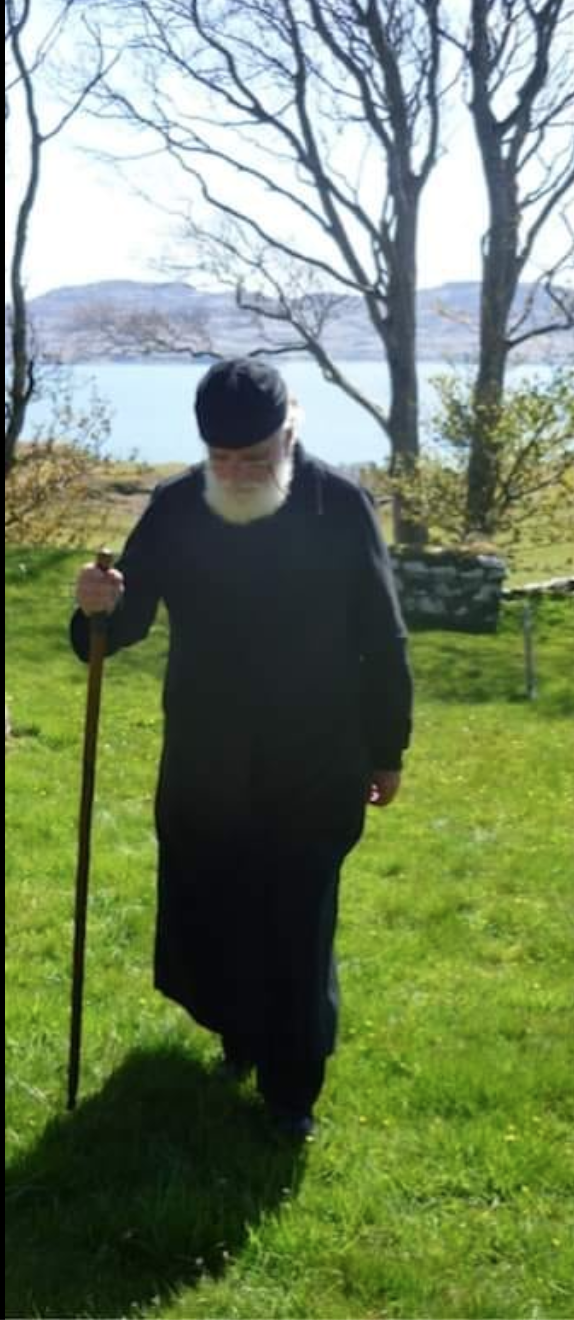
Fr Michael on the island of Mull
The eremitic life is something that few people, even monastics understand. More to the point, it has evolved into various streams over the centuries, to the point that very few understand how it started out, and what that would mean today.
The eremitic choice remains and increases amongst those who have never joined a coenobitic monastery.
In today’s world, unlike the past, when populations were a mere fraction of what they are today, virtually wherever you live on the planet, the world will try to find its way into your cell. Just the relative peace of isolation seems unattainable. Then of course, wherever you are the satanic forces will find you out and seek to steal peace and salvation away from you.
The first recorded Christian hermit is Saint Paul of Thebes, who circa AD250, went into the Egyptian desert to live alone. He found a hidden, ancient disused complex, ringed and enclosed, with water and date palms, and there he lived for around a hundred years.
The hermit lives essentially alone. He may have a small farm to sustain himself, or he may make things to sell to sustain himself. He spends much of his time in prayer.
Abba Philemon said: “By means of silence you can thoroughly cleanse your mind and give it constant spiritual occupation. As the eye turned on sensory objects looks closely at what it sees, so a pure mind that turns toward spiritual things is uplifted by the object of its contemplation. The mind becomes perfect when it enters into the sphere of essential knowledge and is united with God. Having thus attained kingly rank, the mind is no longer poor and it is not carried away by false desires, even if all the kingdoms of the world were offered to it.”
Usually the hermit will start out using the typical monastic Offices of Matins, Lauds, Prime, Terce, Sext, None, Vespers and Compline. However over the years of this, he will gradually move from these set forms towards a more continuous conversation with God. This allows God to draw closer and he might begin to experience this closeness. This “further conversation” with God becomes increasingly a two way thing, but eventually developing into a near one way thing from God to the hermit and over decades may become an almost continuous occurrence, a sort of “God-thinking”.
Usually this starts out with the practice of a method of mental self-discipline that involves the use of the Jesus Prayer of which there are several versions “Lord Jesus Christ Son of the Living God have mercy upon me a sinner” or the earlier “O God, make speed to save me: O Lord, make haste to help me” assisted in some cases, by certain techniques which limit the input of external stimuli.
From the beginning of the eremitic life, it is necessary that the hermit obtain control over himself, his thoughts and actions, his obsessions, even his interests. This means at the early stage the following of the round of prayer given us in the monastic Hours. In between he must follow the course of the Jesus Prayer while pursuing his work.
Practically, the hermit lives alone, therefore, unlike the coenobitic monk, he must have possessions. In the distant past it was possible for a would-be hermit to approach a great land owner and beg a small isolated piece of land where he could cut trees, build a basic hut/cottage and grow sufficient food to sustain himself.
Rarely that can be done today, it is usually a much more complicated task. So practically, the modern hermit must own his cell, which means buy it, which means first acquire the money to do so. Talking £100,000 – £250,000, we get into the realm of mortgages, which means that the hermit must have regular employment, which means that he is effectively not a hermit unless he is able to work from home. This also works if the hermit is merely renting – the amount required per month is not much different from mortgage payments. I know of only two hermits in Britain who have been able to gain stable accommodation from landowners. And I know of only two who have been able to earn a living from home.
So the hermit owns/controls property of some sort and must engage with the world in order to sustain himself since growing his own vegetables may not be an option. This substantially limits the living of a true eremitic life.
Today however, there are limited opportunities to work from home using a computer, teaching online, processing information online, maybe also running an income-earning website. There are also opportunities for a hermit to work substantially alone outside his home, doing craftwork or setting up as a local gardener, lawnmower man etc.
Repentance is a major element of the monastic and eremitic process. Repentance involves first the individual seriously, at length, determining that previous wrong actions, thoughts etc., must be re-thought and thus remedied, allowing God to judge and then transform the hermit in this lifetime on earth.
Then there is the practical obedience that runs a Hermitage. The important thing is the spiritual dimension. There is a point to the monastic subjecting himself to another’s will and that is his ultimate goal. It is, if you like, practice. The individual must subject himself to the will of God, that we all understand at least intellectually. However like intellectual assent to the existence of God in no way equating to Faith in God, similarly, intellectual assent to the will of God in no way equates to genuine obedience to God.
For this reason, we practice obedience to some earthly “master’, be that the bishop, the Abbot, or the Spiritual Father or the Anamchara. That obedience, over time develops. As it develops, it changes from obedience, to unity of purpose. Once that unity of purpose is achieved, there is no sense of subjugation, but only of unity of will. This puts us on the road to theosis.
Pride may not be apparent to anyone else or even to oneself, because it is a very subtle form of demonically induced delusion. In such delusion they imagine that they are privileged to enter into intimate conversation with God at a comparatively early stage and are often led to disclose this to others. Such persons are usually just talking to satan himself. They feel that they are reaching theosis after just a few years as monks or hermits, when in fact nothing could be further from the truth. Satan finds such delusion to be a marvellous way to distract the monk from his necessary path of repentance.
He hath scattered the proud in the imagination of their hearts” “and hath exalted the humble and meek.
(Luke 1:51-52)
Do nothing from selfishness or conceit, but in humility count others better than yourselves. Let each of you look not to his own interests, but also to the interests of others. Have this mind among yourselves, which you have in Christ Jesus.
(Phil 3:3)
Aphrahat the Persian said: From the moment you start praying, raise your heart upward and turn your eyes downward. Come to focus in your innermost self and there pray in secret to your heavenly Father.
Aceticism is a very odd phenomenon. What all hermits have in common is a desire to chase after God, to reach a point where God is willing to come close to them and a conversation of sorts may ensue. They seek the ultimate goal of theosis, which I would define as the full alignment of the individual’s will with the will of God.
Evagrios of Pontus said: “Can you imagine any greater thing than to have communion with God Himself and to be wholly absorbed in Him?”
Maximos the Confessor said: “A soul can never attain to the mystical knowledge of God unless and until God himself stoops down in mercy to grasp it and then lift it up to himself. The spiritual intellect of a human being lacks the power, of itself, to ascend and participate in divine illumination. God must first draw the intellect on high – insofar as it is possible for the humanity – and then illuminate it with the rays of divine light.”
And so we are introduced to the mystical aspect of eremitic life. This mystical aspect is inevitable, it goes hand in hand with eremiticism. Makarios the Great said: “When a soul is full of expectant longing, and full of faith and love, God considers it worthy to receive “the power from on high” [Acts 1:8, 2:1-3], which is the heavenly love of the Spirit of God and the heavenly fire of immortal life; and when this happens, the soul truly enters into the beauty of all love and is liberated from its last bonds of evil.”
The luminous quality of the world to come is now here with us, as shown from the Celtic eremitic writings and in the lives led by those hermits of the past and also in the lives of those today living the genuine life. Hesychasm is itself the living of the mystical Christian life, and it is the basis of the eremitic life.
Philo (30 B.C-A.D. 50) taught that every man, by freeing himself from matter and receiving illumination from God, may reach the mystical, ecstatic, or prophetical state, where he is absorbed into the Divinity.
The idea of mystical realities has been widely held in Christianity since the second century, referring not just to spiritual practices, but also to the belief that the Liturgy, Baptism etc., and the Scriptures have hidden mystical meanings and interpretations.
Saint John is held as the mystic Gospeller and his Book of the Revelation is the culmination of this.
Following on from Saint John, mysticism and the vision of the Divine was introduced by the Fathers, who used the ideas of mystical theology and mystical experience.
For the one who involves himself in the continuous prayer, graduating to the ongoing conversation-communion with God this luminous world filled with the Uncreated Light, becomes at least in part, his experience. If not the actual Uncreated Light experience of Mount Tabor or Saint Seraphim, nevertheless the experience of this world in a totally otherworldly manner. The Celtic Christian idea of “thin places” was not without foundation, The nearness of the world beyond becomes palpable to those who are themselves “not of this world”.
The first stage is purification whereby the mystic should start. This focuses on discipline, particularly in terms of the body emphasising prayer at set times, and perhaps particularly standing or kneeling. It involves other physical disciplines – fasting, works of mercy, such as feeding the hungry and homeless.
Only a few hermits – monastics ever achieve the reward of the Uncreated Light as for instance, recorded by Motovilov, the witness of Saint Seraphim of Sarov’s reward. Others receive a glimpse, a fleeting second of Uncreated Light. For most of us, our first experience of Uncreated Light will be after we die. The fathers taught that the vision of God is the work of grace and the reward of eternal life; in the present life only a few souls, by a special grace, can reach it.
“During prayer, attention must be inside, in the heart: concentration of attention in the heart is the starting point of proper prayer. And because prayer is the way of ascent to God, then deviating attention from the heart is evading this way.” -St. Theophan the Recluse
Following the fathers, generations of Hermits have evolved practices of prayer which they found to be of great assistance in their journey towards theosis. Grouped under the heading of hesychasm, this involves acquiring an inner focus and blocking of external stimuli.
This prayer life is, for the genuine hermit, his real life it is his very existence, it is the entrance doorway to the eternal life with God. It is all-important, engrossing and the only (for him) worthwhile way of living.
 SAINT ADAMNAN OF IONA